


Most lenders do not have a lead problem. They have a follow up problem.
Leads come in from many places. Field visits, inbound calls, referrals, websites, and social campaigns. Then reality hits. The prospect is busy. The phone number is wrong. The loan officer forgets. A supervisor only notices weeks later, when pipeline numbers drop.
Juakali Lead Management is built for that gap. It gives lending teams a lightweight way to capture leads, qualify them, and run structured follow ups until a prospect is ready to become a real loan application.
A lead is not an application, it is someone who might borrow, but is not ready yet. They need a call back next week. Or they want to wait for the next harvest. Or they want to ask their spouse. Or they just want to understand pricing.
If you treat every lead like a full loan application, you create unnecessary work. Officers get overwhelmed and follow up becomes inconsistent. Juakali separates the early stage pipeline from the loan origination process. That keeps lead capture fast, and it keeps the conversion step clean.
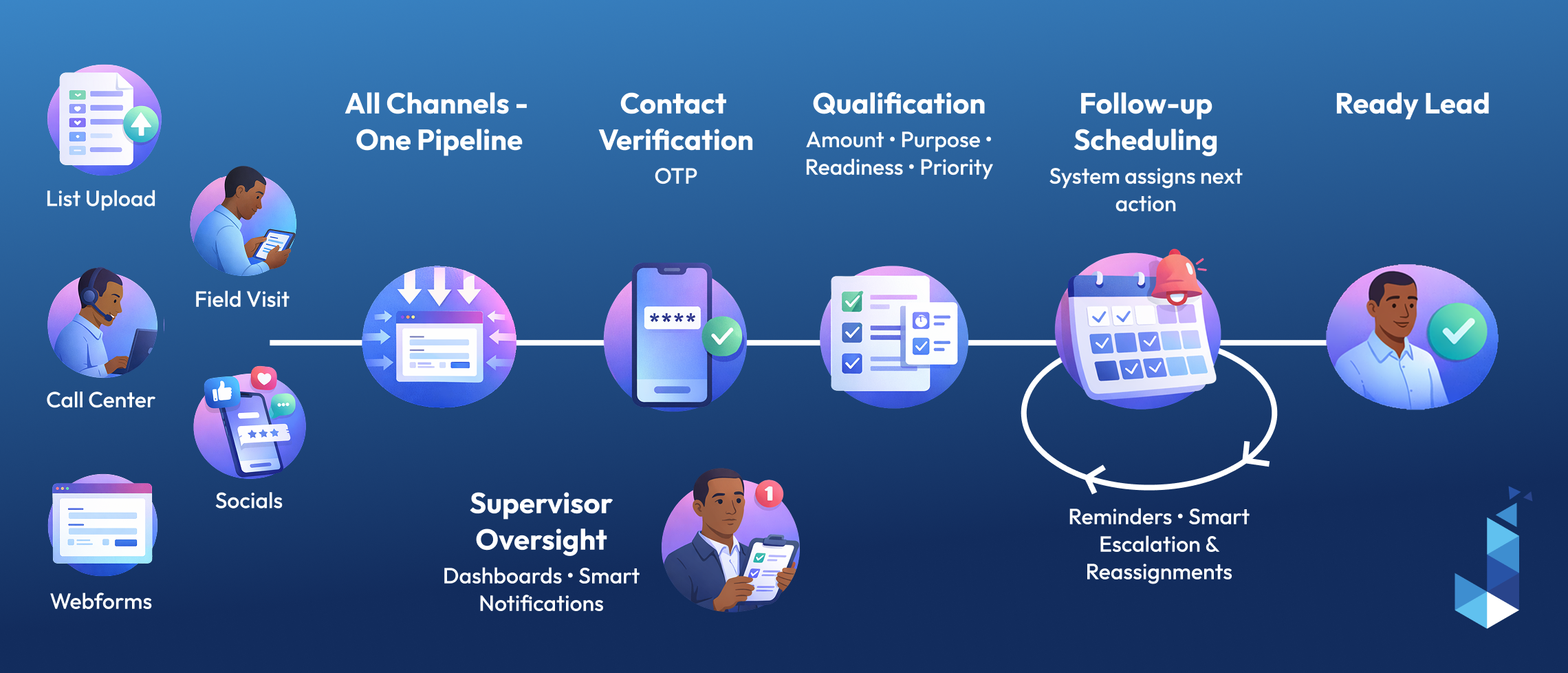
Juakali can collect leads through:
This matters because most institutions have more than one acquisition channel. A lead workflow should not break as soon as marketing, a call center, or branches get involved.
Follow up fails if contact details are wrong.
Juakali can verify the prospect’s phone number via a one time password (OTP). This improves data quality. It also helps supervisors trust the pipeline, because it reduces the risk of fake or unreachable leads.
Juakali captures lightweight qualification data, such as:
Then it asks the questions that actually determine the next step.
Readiness: when is the prospect ready to start an application?
A simple set of options works well, for example:
Priority: how important is this lead?
Officers can mark leads as low, medium, or high priority. This is not a guess about conversion. It is a way to allocate attention when capacity is limited.
Once readiness and priority are set, the next action becomes obvious.
Juakali can schedule follow ups and automate reminders, for example:
This turns follow up into a system, not a memory test.
In most institutions, missed follow ups are invisible.
Juakali supports supervisor oversight through escalation rules.
If a follow up is missed beyond a configured grace period:
Supervisors can also rebalance workloads in batches, not only one lead at a time. This matters when a team is scaling, or when coverage changes between regions.
When a prospect confirms they are ready, Juakali can move them into the loan origination workflow.
The information collected during lead management carries over. That reduces re entry, speeds up the first application step, and keeps the customer experience consistent.
Lead management needs to fit how your institution works. Some lenders want loan officers to capture and follow up themselves. Others want a call center or sales team to qualify inbound leads first, then assign only qualified leads to field officers. Juakali supports both models:
Some institutions deal with a high volume of unqualified applications. One practical approach is to introduce a small application fee step, or another eligibility gate, before a prospect progresses further. If the institution has the right payment integration in place, Juakali can check whether the fee has been paid before continuing. If not, the workflow can still support a manual confirmation step. The point is not the fee itself. The point is that you can design a funnel that protects staff time.
When lead management is structured, a few things happen quickly:
If you are losing leads today, start by making follow up visible. Then add reminders. Then add escalation and reassignment. Juakali Lead Management is designed to support that progression, and to hand off cleanly into loan origination once a prospect is ready.
