


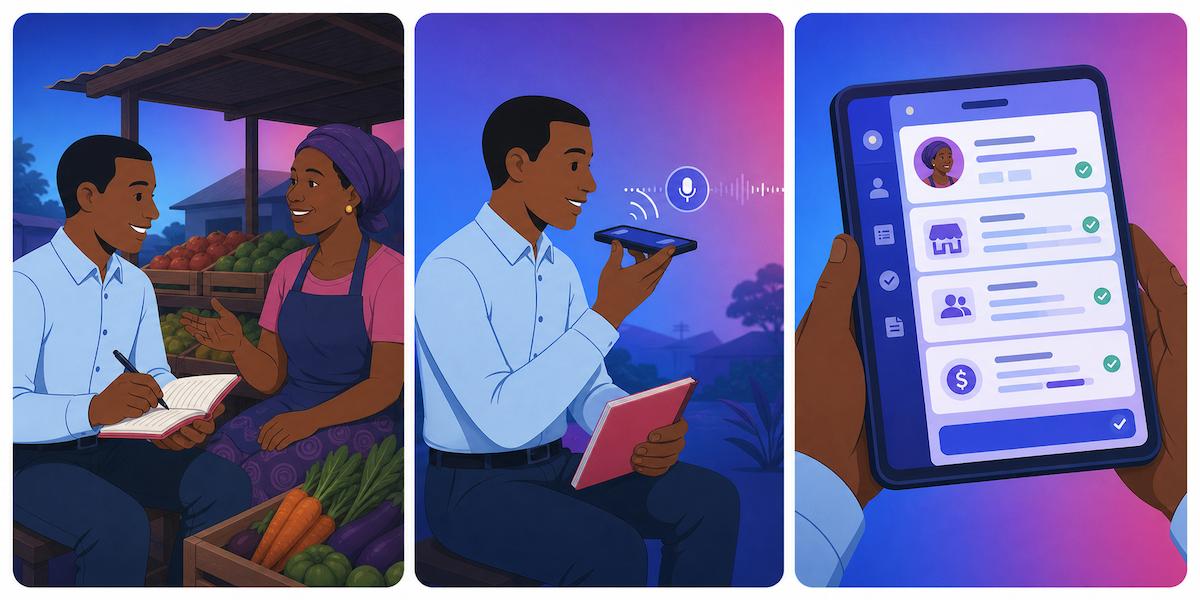
One of the awkward moments in a customer meeting is when a loan officer has to stop listening and start typing.
The conversation may be going well. The officer is learning about the business, the household, the purpose of the loan, and the details that will matter later in appraisal. Then attention shifts to the phone and the rhythm changes. That is one reason paper notes still exist in many field teams, even where the institution is serious about digitization.
Juakali has built an AI transcription feature for loan origination with that reality in mind. The idea is simple: let the officer handle the meeting naturally, then let them dictate the key details into the Juakali DFA afterwards so the system can populate the form.
Here is the kind of note that might be recorded after a visit:
"Just met Mary Atieno near Yaya Centre. She runs a small fruit and veg shop there. She is asking for fifty thousand shillings to buy a small fridge, mainly to keep produce fresh longer. She has three kids. She said sales are usually around six to seven thousand a day, but it moves around a bit."
Juakali can use that note to draft the key fields straight into the form:
The officer still reviews the populated fields. The workflow, validations, and approval process do not disappear. What changes is that the officer no longer has to re-enter everything line by line after the meeting.
That may sound like a small improvement, but it speaks to a bigger issue in microfinance operations. Field work is relational. Form filling is administrative. Both matter, but they do not have to compete with each other as much as they often do today.
The phrase "high-tech, high-touch" is useful here. MFIs are often already strong on the high-touch side. Their teams know how to build trust, explain products, and work closely with customers. The harder part is keeping that closeness while also improving speed, consistency, and data quality.
This is where AI can be useful, not as a replacement for judgment, and not as the center of the product, but as a practical tool inside a structured workflow. If it helps an officer stay present in the meeting and still get clean information into the system afterwards, that is already valuable.
For MFIs, that may be the more interesting direction: keep the human interaction, tighten the workflow around it, and use technology where it genuinely removes friction.
